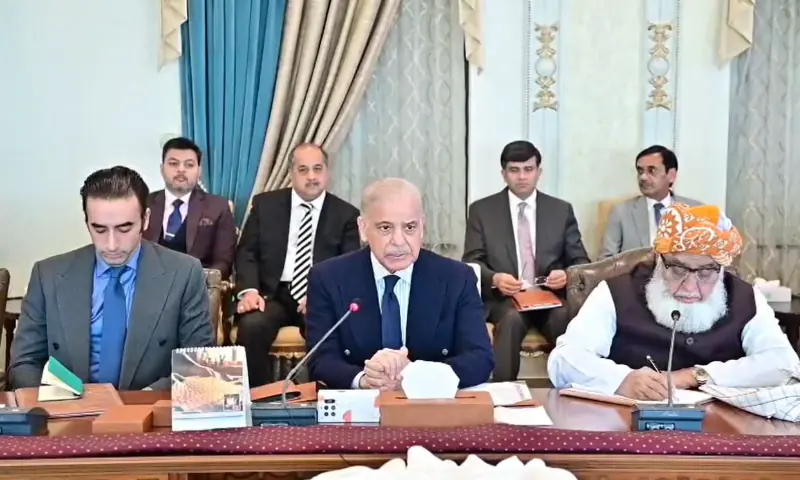
ISLAMABAD — Prime Minister Shehbaz Sharif on Wednesday chaired an in-camera briefing for leaders of parliamentary parties to discuss the evolving regional security situation, including the Pakistan-Afghanistan border dynamics, ongoing counterterrorism operations and the escalating conflict in the Middle East.
Operation Ghazab-Lil-Haq: Pakistan Claims Major Losses for Afghan Taliban
The meeting, which began shortly after 11:30am and lasted more than two hours, focused on Operation Ghazab lil-Haq against militant hideouts as well as hostilities involving Iran and Gulf states, according to a statement issued by the Prime Minister’s Office (PMO).
“The meeting was given an in-camera briefing regarding the Pakistan-Afghanistan situation, the hostilities in Iran, Middle East and the Gulf, and Pakistan’s diplomatic efforts,” the PMO said. It added that parliamentary leaders freely expressed their views and underscored the need for national unity and consensus amid the current challenges.
The government had invited all major political parties, including the Pakistan Tehreek-e-Insaf (PTI), to develop a joint course of action. However, PTI declined to attend, reiterating that it would not participate in meetings unless access was granted to its founder, Imran Khan.
Among prominent attendees were Bilawal Bhutto-Zardari, chairman of the Pakistan Peoples Party, and Fazlur Rehman, chief of Jamiat Ulema-e-Islam (F). Other party leaders present included representatives from the Muttahida Qaumi Movement-Pakistan, Istehkam-e-Pakistan Party, Balochistan Awami Party and Pakistan Muslim League (Q).
Senior parliamentary officeholders, including Senate Chairman Yousaf Raza Gilani and National Assembly Speaker Sardar Ayaz Sadiq, also attended, along with members of the federal cabinet such as Deputy Prime Minister and Foreign Minister Ishaq Dar.
The PMO statement said participants reaffirmed their commitment to eradicating terrorism and praised the prime minister for taking the political leadership into confidence during a critical period.
Pakistan’s Diplomatic Push on Iran Conflict
Speaking after the meeting on Geo News, PM’s Adviser on Political Affairs Rana Sanaullah said Pakistan was actively pursuing diplomatic engagement to help bring about an agreement to end the war involving Iran.
He stated that Pakistan was facilitating communication efforts and engaging both political and military leadership channels to prevent further escalation, particularly discouraging Iranian strikes on Gulf countries.
“If the attacks on Gulf countries stop and those countries also support efforts to end the war, then the chances of an agreement increase,” Sanaullah said, adding that various leaders, including Bilawal Bhutto-Zardari, had offered recommendations for a coordinated strategy.
Sanaullah maintained that while Iran had the right to respond to aggression, unchecked escalation could weaken unity among Muslim countries. He warned that if the conflict intensifies further, it could present significant challenges for the United States and destabilize the broader region.
The government emphasized continued diplomatic engagement aimed at de-escalation, regional stability and safeguarding Pakistan’s national interests amid mounting geopolitical tensions.