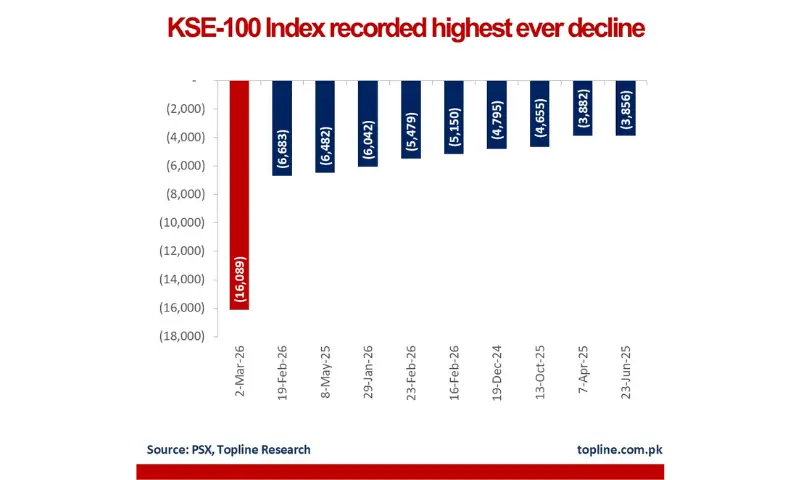
KARACHI: Pakistan’s stock market witnessed an unprecedented sell-off on Monday as the benchmark KSE-100 Index recorded its largest single-day decline in history, falling by 16,089.17 points after trading resumed following a temporary halt triggered by panic selling.
India’s $60bn River Storage Plan Raises Flood and Drought Concerns for Pakistan
The benchmark index of the Pakistan Stock Exchange (PSX) initially crashed by more than 15,000 points at the opening bell, forcing authorities to suspend trading shortly after the session began amid extreme volatility.
According to Topline Securities Chief Executive Officer Mohammed Sohail, the market “overreacted initially” due to aggressive selling by a limited number of funds and leveraged investors.
When trading resumed around 10:30am, the index stood at 12,334.88 points below its previous close of 168,062.16, reflecting a decline of 7.34 per cent. Buying interest later emerged as investors considered valuations attractive after the market had already corrected nearly 20 per cent from its recent peak.
By late morning, losses narrowed slightly, with the index down 9,164.62 points, or 5.45 per cent. However, renewed selling pressure pushed the market sharply lower again, with the index closing at 151,972.99 points, down 9.57 per cent for the day.
Among the most actively traded stocks, K-Electric Limited fell 12.53 per cent to Rs6.70 on heavy volumes, followed by Worldcall Telecom Limited, which declined 13.18 per cent, and First National Equities Limited, which dropped over 20 per cent.
Topline Securities reported that heavyweight companies — including Fauji Fertilizer Company, United Bank Limited, Engro Holdings Limited, Hub Power Company, and Meezan Bank Limited — collectively dragged the benchmark index down by more than 5,000 points.
Despite the steep losses, market activity remained strong, with total trading volume reaching 809 million shares and turnover recorded at Rs48.5 billion.
Analysts linked the sharp decline to rising geopolitical tensions after the United States and Israel launched joint strikes on Iranian targets over the weekend, escalating global uncertainty. The developments pushed Brent crude prices up 6.4 per cent to $77.57 per barrel, while US crude rose 6.2 per cent. Meanwhile, gold prices climbed 1.6 per cent as investors shifted toward safe-haven assets.
Research firm AKD Securities noted that a market recovery remains possible, stating that Pakistan’s direct economic exposure to the conflict appears limited and the country is not an active party to the confrontation.