President Asif Ali Zardari’s warning that present-day Afghanistan resembles the conditions preceding the September 11, 2001 attacks carries serious weight. As during the Taliban’s first rule, militant groups once again appear to be operating with relative freedom across the border. While outfits such as Islamic State–Khorasan (IS-K) are hostile to the Afghan Taliban, others — most notably the Tehreek-i-Taliban Pakistan (TTP) — maintain cordial relations with Kabul’s rulers.
Pakistan Urged to Establish Data Governance Before AI Framework
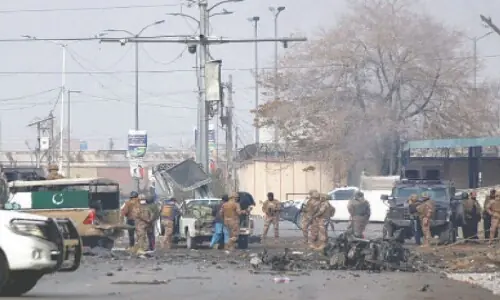
The president’s assertion that India is assisting the Taliban regime and threatening Pakistan adds another layer to an already complex security environment. In the same vein, the federal interior minister recently disclosed that the alleged mastermind behind Friday’s suicide attack in Islamabad was an Afghan national, while IS has claimed responsibility for the bombing. The minister also alleged increased Indian funding for terrorist elements.
These overlapping internal and external threats make it imperative for federal and provincial governments to rise above political divisions and concentrate on combating terrorism. Unfortunately, flippant remarks by the federal information minister — including an off-colour joke blaming the PTI for the resurgence of terrorism — undermine the sense of unity urgently required at this critical juncture.
There have been encouraging signs. Last week, Khyber Pakhtunkhwa Chief Minister Sohail Afridi chaired his first Apex Committee meeting, emphasising coordination among provinces, the federal government and the military. Similarly, the interior minister publicly commended the KP Counter Terrorism Department for its role in arresting suspects linked to the Islamabad attack.
All political stakeholders must now demonstrate the same maturity and restraint. This is not the moment for snide remarks or renewed arguments over who enabled terrorist groups to regroup — a debate that would inevitably stretch back decades and implicate multiple actors and policies. The priority must remain singular: defeating terrorism.
The reported involvement of IS in the attack on an Islamabad imambargah is particularly alarming. Although IS and the Afghan Taliban are adversaries, the group continues to operate in the Pakistan-Afghanistan border regions. Its ability to strike apparently from KP and target the country’s most secure city should set off serious alarm bells.
Pakistan is already grappling with an intensifying TTP threat. It cannot afford complacency on another front. Enhanced intelligence-based operations are essential to pre-empt future attacks and ensure that IS is given no space to entrench itself further.