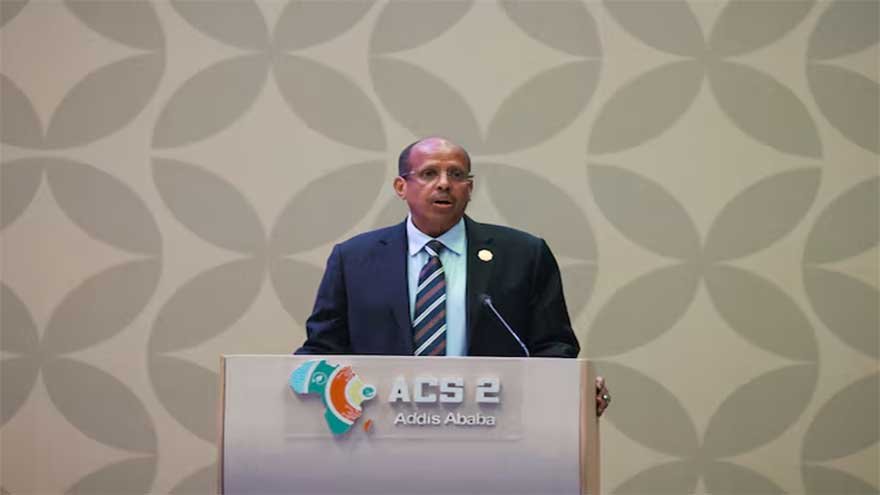
The African Union Commission Chairperson, Mahmoud Ali Youssouf, has firmly rejected claims by former U.S. President Donald Trump that a “genocide” is taking place in northern Nigeria, saying there is no evidence to support such allegations.
India Defends Wildlife Imports Amid Scrutiny Over Ambani Family’s Vantara Zoo
Speaking to reporters at the United Nations in New York on Wednesday, Youssouf said the situation in northern Nigeria cannot be compared to the atrocities witnessed in Sudan or the eastern Democratic Republic of Congo (DRC).
“What’s going on in the northern part of Nigeria has nothing to do with the kind of atrocities we see in Sudan or in some part of eastern DRC,” Youssouf said. “Think twice before making such statements. The first victims of Boko Haram are Muslims, not Christians.”
His comments came in response to Trump’s recent claim that “very large numbers” of Christians were being killed in Nigeria, and his suggestion that the U.S. military might take “fast action” if the Nigerian government failed to stop the alleged killings.
Trump provided no evidence for his accusation but went as far as threatening to cut aid to Nigeria and even launch a military intervention, vowing to “wipe out Islamic terrorists.”
The extremist group Boko Haram, which has waged an insurgency in northeastern Nigeria for nearly 15 years, has been responsible for tens of thousands of deaths. Human rights organizations and security experts say the majority of victims have been Muslims, not Christians, contradicting Trump’s assertion.
Nigeria’s Foreign Ministry responded by reaffirming its commitment to combating violent extremism and protecting all citizens regardless of faith or ethnicity. “Nigeria will continue to defend all citizens, irrespective of race, creed, or religion,” the ministry said in a statement, emphasizing that it values its partnership with Washington.
With more than 200 ethnic groups and a population split between Christianity, Islam, and traditional faiths, Nigeria has long been seen as a model of religious coexistence in Africa, despite sporadic outbreaks of ethnic and sectarian violence often linked to resource competition rather than religion.