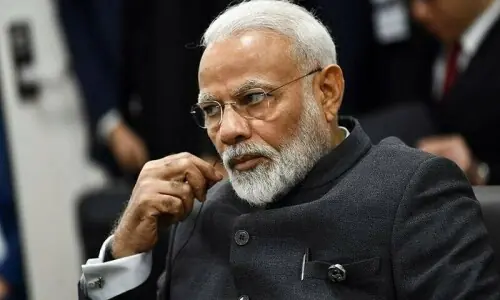
India’s main opposition party, the Indian National Congress, on Thursday criticised the government led by Narendra Modi after the United States temporarily allowed Russian oil stranded at sea to be sold to India, saying the move raised questions about the country’s autonomy in matters of national interest.
Pakistani Evacuee’s Remark on Tehran Explosions Goes Viral Amid Iran Conflict
The waiver was announced by US Treasury Secretary Scott Bessent, who said the decision aimed to “enable oil to keep flowing into the global market.” The move comes amid heightened tensions in the Middle East following the recent US-Israeli attack on Iran, which has created uncertainty in global oil markets.
India had earlier indicated it would stop purchasing Russian oil as part of a trade agreement with the United States. However, the latest development prompted strong criticism from the Congress party, which questioned why Washington should have any role in determining India’s energy decisions.
In a post on the social media platform X, Congress said the situation suggested that the United States was effectively deciding where India could buy oil from. “This decision is not being made by Prime Minister Modi, nor by the Indian government,” the party said.
The opposition party also said Indian citizens were asking why the US should “permit” India to purchase oil. “We are not slaves to any nation; we are a sovereign and independent country. Period,” the statement added.
Congress further alleged that Modi was unable to challenge US authority because he had compromised India’s interests in favour of Washington. The party’s Karnataka unit also questioned why India would need approval from former US President Donald Trump to make decisions in its own national interest.
Earlier, the US government temporarily eased sanctions on Russia to allow Russian oil currently stranded at sea to be sold to India. The US Treasury Department’s Office of Foreign Assets Control issued a licence authorising the delivery and sale of crude oil and petroleum products of Russian origin loaded on vessels as of March 5, 2026, to India.
According to the Treasury Department, the transactions — including shipments from vessels affected by sanctions — will be permitted until the end of April 3, 2026.
Bessent said the short-term waiver would not significantly benefit the Russian government as it only covered oil already stranded at sea. He added that the measure would help ease pressure caused by Iran’s attempts to disrupt global energy markets.
The development comes against the backdrop of ongoing sanctions on Russia following its 2022 invasion of Ukraine. In November last year, Trump imposed sanctions on major Russian oil companies, including Lukoil and Rosneft, in a bid to pressure Moscow over the conflict.
Russia has since reportedly relied on a fleet of ageing oil tankers with opaque ownership structures to bypass sanctions imposed by the United States, the European Union and the G7 countries.