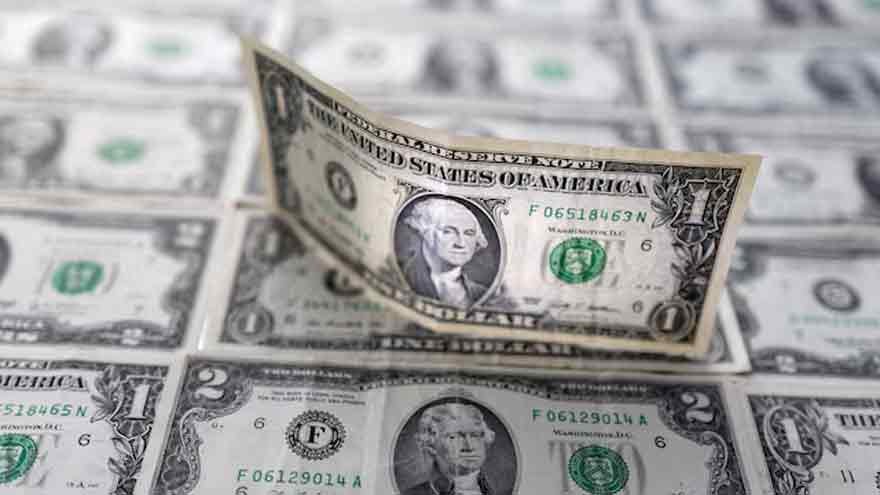
The U.S. dollar weakened on Friday and was on track for a weekly decline as investors awaited a backlog of key economic data following the government’s reopening—figures widely expected to reveal further signs of a slowing economy.
Oil Prices Climb After Ukrainian Drone Strike Hits Major Russian Export Hub
Asian trading saw sharp movements across major currencies. The British pound and South Korean won posted outsized swings, while China’s onshore yuan strengthened to its highest level in more than a year.
A more hawkish shift in U.S. interest rate expectations remained the central market theme. Traders now assign less than a 50% probability to a 25-basis-point rate cut in December after fresh remarks from Federal Reserve officials underscored caution about further easing, citing persistent inflation and a stable labour market.
Despite the reduced rate-cut bets, the dollar failed to find support. It slipped against the euro, which climbed back above $1.16 to trade at $1.1641. The Swiss franc hovered near a three-week high at 0.7920 per dollar. The dollar index remained near a two-week low at 99.11 and was headed for a weekly loss of 0.45%.
“Starting next week, we’re going to get a lot of economic data from the U.S., and we think it’s going to be pretty bad,” said Joseph Capurso, head of foreign exchange international and geoeconomics at the Commonwealth Bank of Australia. He added that uncertainty caused by patchy or missing datasets may explain why interest rate futures have moved in a counterintuitive direction.
The White House has already indicated that the U.S. unemployment rate for October may never be released because the necessary household survey was not conducted during the shutdown. “When you’re in the fog, you drive slower… when you don’t know what’s going on in the economy, maybe you slow down your cuts,” Capurso said.
Expectations for U.S. rates in 2026 remain largely unchanged, with a January cut almost fully priced in.
Sterling slipped 0.32% to $1.3149 after briefly rebounding overnight. The decline came after a Financial Times report said Prime Minister Keir Starmer and Finance Minister Rachel Reeves had abandoned plans to raise income tax rates ahead of the November 26 budget.
“If fiscal tightening won’t be as drastic, that’s less negative for the economy, but foreign investors in the gilt market may be concerned about the fiscal outlook,” said Ray Attrill, head of FX research at National Australia Bank.
The South Korean won climbed 1% after authorities signaled readiness to stabilise the volatile currency and were suspected of intervening through dollar sales. The yen saw modest relief from the dollar’s pullback but remained near a nine-month low at 154.34 per dollar, poised for a 0.6% weekly decline.
In Australia, the Aussie edged up 0.22% to $0.6545 after falling earlier on expectations of higher-for-longer U.S. interest rates. The New Zealand dollar gained 0.64% to $0.5690, supported by data showing a pickup in October manufacturing activity and news that the Reserve Bank of New Zealand will loosen mortgage loan-to-value restrictions from December 1.
China’s onshore yuan reached a one-year high of 7.0908 per dollar, boosted by exporter dollar selling after a key level was breached. However, fresh data showed new home prices in China fell at their fastest monthly pace in a year in October, underscoring persistent weakness in the troubled property sector.