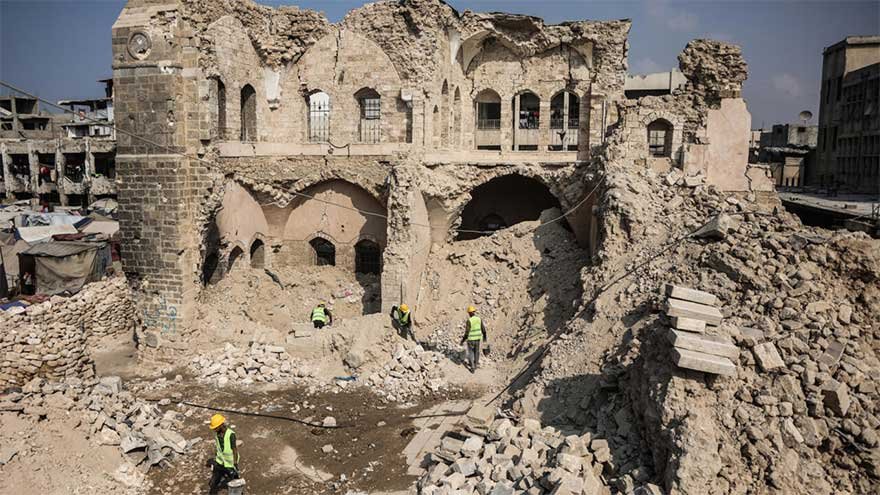
One bucket at a time, Palestinian workers on Thursday painstakingly cleared sand, debris and fractured stone from the remains of Gaza City’s historic Pasha Palace Museum, a medieval fortress-turned-museum devastated after two years of war between Israel and Hamas.
Two Palestinians Killed in West Bank as Israeli Settler Violence Sparks Global Condemnation
Wearing high-visibility vests, a dozen workers used only their hands and simple tools to excavate what is left of the ancient complex—said to have once hosted Napoleon Bonaparte during a brief stay in Gaza—sorting reusable stones into one pile and shattered rubble into another.
Above them, an Israeli surveillance drone hovered constantly.
“The Pasha Palace Museum is one of the most important sites destroyed during the recent war on Gaza City,” said Hamouda al-Dahdar, the cultural heritage expert overseeing the restoration. He estimated that more than 70% of the structure has been destroyed.
Heritage Sites Across Gaza in Ruins
According to UNESCO, by October 2025 at least 114 cultural and historic sites in Gaza had suffered damage since the war erupted on October 7, 2023. These include the Saint Hilarion Monastery—one of the oldest Christian monastic sites in the Middle East—and Gaza City’s iconic Omari Mosque.
But local experts say the true figure is much higher.
Shortages Keep Restoration Efforts Barebones
Issam Juha, director of the Centre for Cultural Heritage Preservation based in the West Bank, said the biggest challenge is the near-total lack of materials entering Gaza.
“There are no more materials,” Juha told AFP. “We are only managing debris—collecting stones, sorting them—and performing minimal intervention.”
Israel’s tight restrictions on goods entering Gaza since the start of the war have led to acute shortages of construction supplies, food, fuel, and medicine.
Even after a US-brokered ceasefire in October enabled more aid trucks to enter, every item still requires strict Israeli approval.
The calmer conditions, at least, have allowed workers to return to archaeological sites without fearing drone strikes.
“Before, it was unsafe,” Juha said. “People were threatened by drones scanning the place and shooting.”
Juha said his teams have recorded 226 damaged heritage sites, far more than UNESCO, because they have access to more locations.
Centuries of Palestinian History at Risk
For Dahdar and his team, the task is urgent.
“Our cultural heritage is the identity and memory of the Palestinian people,” he said. Before the war, the Pasha Palace housed more than 17,000 artefacts. All of them, he said, “disappeared after the invasion of the Old City of Gaza.”
So far, the team has recovered only 20 artefacts, spanning the Roman, Byzantine and Islamic periods.
Gaza’s history stretches back millennia, shaped by civilisations including the Canaanites, Egyptians, Persians, Greeks and early Islamic dynasties.
Inside the ruins, workers brushed dust from carved stones—one bearing a cross crowned with an Islamic crescent, another decorated with elegant Arabic calligraphy.
“We are not talking about just an old building,” Dahdar said. “We are dealing with structures from different eras. We are salvaging every stone we can in preparation for future restoration.”