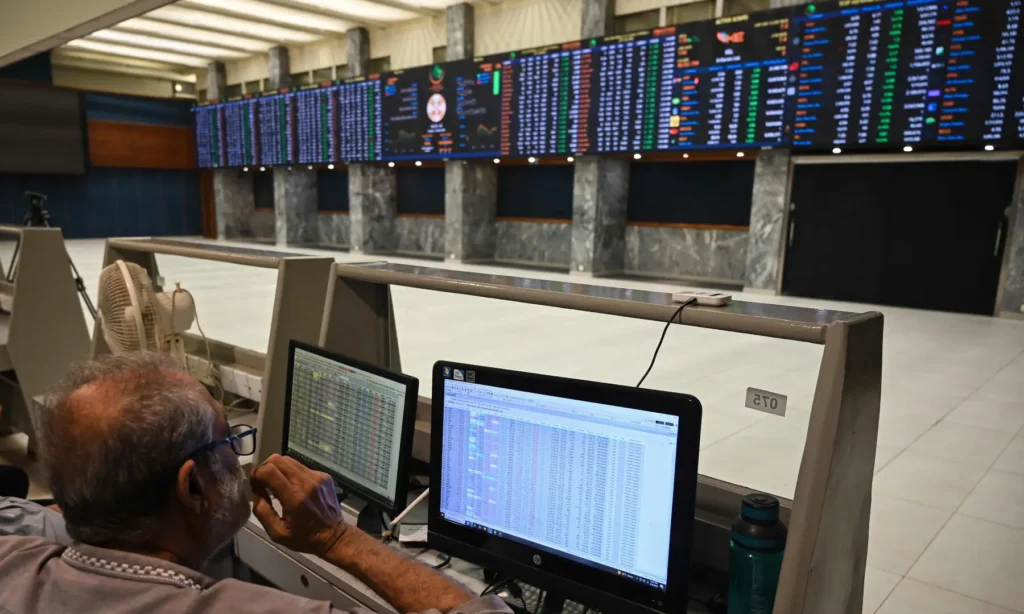
Pakistan’s benchmark stock index staged a strong recovery on Tuesday as the KSE-100 Index surged 9,696.98 points, closing 6.62 per cent higher after the previous day’s steep losses.
Iran War Spillover Poses Economic, Political and Security Challenges for Pakistan
Shortly after trading began, the index climbed 9,303.75 points, or 6.35pc, triggering a temporary market halt due to the sharp rally.
The trading suspension was implemented in line with the rules of the Pakistan Stock Exchange (PSX). According to an official notice, the halt was activated after the KSE-30 Index recorded a 5pc increase from the previous session’s close, which automatically triggers the exchange’s market suspension mechanism. Trading resumed at 10:27am.
Following the resumption, the market continued its upward momentum, with the KSE-100 reaching an intraday high gain of 11,846 points. However, the index later pulled back slightly, touching 10,085.15 points by 12:55pm before trimming some gains and closing firmly in positive territory at 2pm.
Tuesday’s rally came after a major downturn in the previous session. On Monday, the KSE-100 index had plunged to 146,480 points, falling by 11,015 points, or 6.99pc — the second-largest single-day drop in the index’s history — wiping out more than Rs1.09 trillion in investor value.
Market sentiment improved after the State Bank of Pakistan decided to keep its key policy rate unchanged at 10.5pc during the latest meeting of its Monetary Policy Committee. The decision was largely in line with expectations from analysts and market participants.
Global market developments also contributed to the rebound. On Monday, US stocks recovered from heavy losses after former US president Donald Trump suggested that the ongoing US-Israeli war on Iran could be approaching a resolution.
Meanwhile, international oil prices declined on Tuesday after reaching a more than three-year high in the previous session. The drop followed comments indicating that the Middle East conflict may ease soon, raising hopes that disruptions to global energy supplies could be limited.