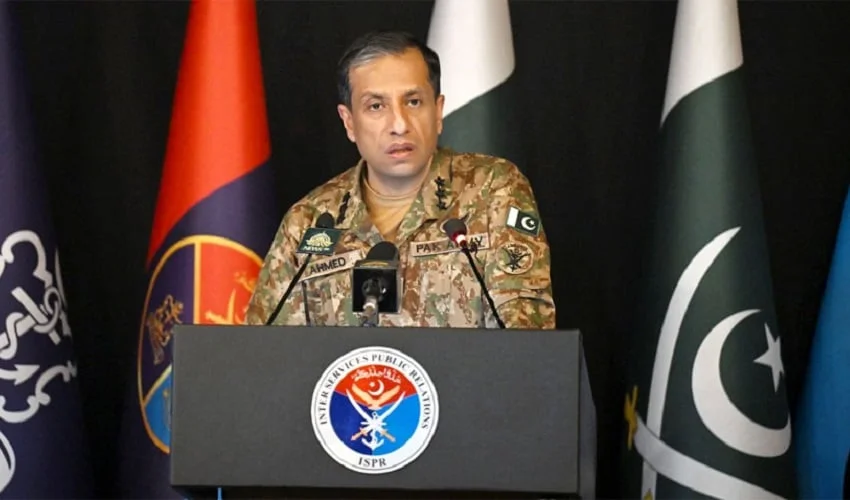
Pakistan’s security forces have carried out 4,910 intelligence-based operations (IBOs) since November 4, eliminating 206 terrorists, Director General Inter-Services Public Relations (DG ISPR) Lt Gen Ahmed Sharif Chaudhry revealed during a comprehensive national security briefing to senior journalists.
Providing year-to-date data, the military spokesman disclosed that 67,023 IBOs were conducted nationwide this year — including 12,857 in Khyber Pakhtunkhwa and 53,309 in Balochistan. A total of 1,873 terrorists have been killed in 2024, among them 136 Afghan nationals.
He warned that Pakistan continues to confront threats from cross-border militancy and transnational criminal networks operating in harsh, mountainous terrain.
Pakistan–Afghanistan border challenges
Lt Gen Chaudhry said effective border management is a shared responsibility, yet the Afghan Taliban regime is “fully facilitating” terrorists infiltrating Pakistan. He rejected propaganda blaming Pakistan for border tensions, stating that Afghan territory remains a sanctuary for banned outfits including al-Qaeda, Islamic State and others.
Key challenges highlighted include:
-
Use of non-custom-paid vehicles in suicide attacks
-
Outposts spread 20–25 km apart along vulnerable stretches
-
Need for extensive observation posts and fire coverage beyond fencing
-
Costly requirements for drones and forts every few kilometres
-
Divided border villages complicating movement control
-
Weak or absent governance in Afghan border regions
“There is a strong political–terror–crime nexus in these areas,” he said.
He added that Pakistan has repeatedly presented evidence to Kabul, stressing that terrorists cannot be considered “guests” and that the Taliban must agree to a verifiable monitoring mechanism under the Doha Agreement — even if supervised by a third party.
US weapons left in Afghanistan pose regional threat
Citing SIGAR data, the DG ISPR said $7.2 billion worth of US military equipment was left behind during the withdrawal, creating major regional security risks. Any nation providing arms to the Afghan Taliban is “effectively empowering terrorists,” he warned.
Pakistan’s selective closure of trade routes with Afghanistan, he noted, is driven by security concerns and protection of citizens.
He also criticised the Taliban’s claim to legitimacy while excluding women — half the Afghan population — from representation.
Sharp response to Indian military rhetoric
Responding to provocative statements by India’s military leadership, Lt Gen Chaudhry said New Delhi remains trapped in “self-deception.”
Referring to the Indian Army chief’s remarks about ‘Operation Sindoor,’ he said:
“If their so-called trailer includes seven aircraft downed, 26 sites hit, and S-400s destroyed, the full movie would be a horror show for India.”
He said India continues to spread false narratives to divert domestic pressure.
Internal reforms, smuggling crackdown and security upgrades
The DG ISPR also outlined key internal counterterror measures:
-
Iranian diesel smuggling cut from 20.5m litres per day to 2.7m after enforcement operations
-
Funds from smuggled fuel were previously channelled to BLA and BYC
-
Implementation of the National Action Plan (NAP) has placed 27 Balochistan districts under police control
-
Daily 140 community engagements — 4,000 monthly — by security forces are showing strong positive impact
He emphasized that such structural reforms are essential for long-term counterterror success.
Foreign networks fuelling online propaganda
Lt Gen Chaudhry stated that many toxic social media accounts targeting Pakistan originate abroad. “Attempts are being made from overseas to inject poison into Pakistan’s politics and society,” he said, highlighting foreign-backed disinformation campaigns against state institutions.