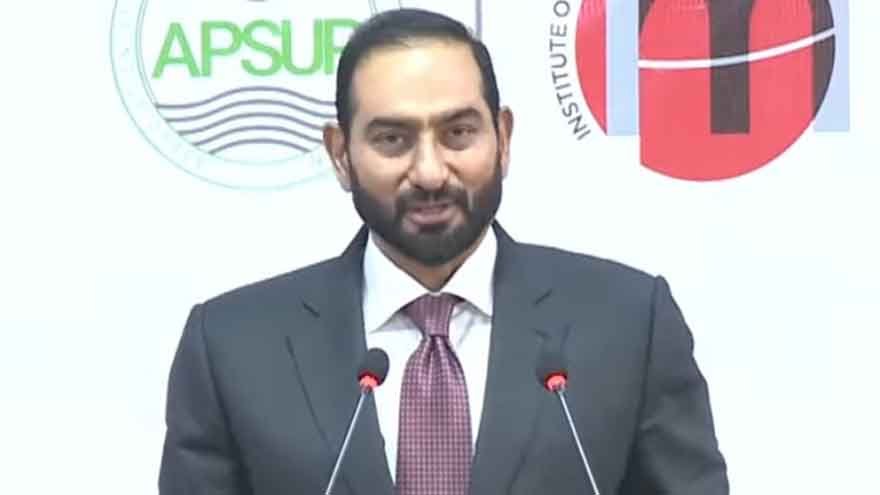
Mian Amer Mahmood has said that Pakistan is not progressing in line with its true potential, despite its resources and strategic position. He was speaking at a session held at IoBM Korangi Creek as part of the Association of Private Sector Universities of Pakistan’s (APSUP) nationwide awareness campaign titled “Pakistan 2030: Challenges, Opportunities and New Pathways.”
CJCSC Gen Sahir Shamshad Mirza Visits Air Headquarters, Receives Guard of Honour
He noted that while neighbouring countries such as China, India, Vietnam and Thailand are advancing rapidly, Pakistan continues to lag behind. “Our country is not advancing according to its capabilities, while nations around us are moving ahead quickly,” he said.
Mahmood stressed that leadership alone was not the issue; rather, no leader in the past eight decades had fully delivered on national responsibilities. He highlighted Pakistan’s unique demographic imbalance, where Punjab accounts for 52% of the population while the remaining three provinces make up 48%. He added that even basic population figures, such as those for Karachi, remain disputed.
Strong institutions, accurate data key to progress
He emphasised the need for strong institutions and reliable data, noting that with systems like NADRA, Pakistan should be able to track its population with precision. “Science has advanced so much that you can even count people through satellites,” he remarked.
Mahmood said a state has seven core responsibilities — public welfare, justice, law and order, economic and political stability, and the protection of national borders. While Pakistan has made progress in some areas, he said the nation has fallen behind globally over time. He cited a World Bank report noting that only five Pakistani cities show signs of comprehensive development.
Weak institutions fuelling corruption
He argued that weak institutions have allowed personal influence and corruption to flourish. “Local governments are the best system to resolve everyday problems, yet every democratic government abolishes them as soon as it comes to power,” he said. Creating smaller provinces, he added, would allow for more effective governance.
Mahmood compared Pakistan with other populous nations, noting that most countries have far more administrative units. He said Pakistan’s four provinces are disproportionately large: Balochistan, nearly half of Pakistan’s landmass, has just 15 million people, making law and order a significant challenge.
He added that Pakistan ranks poorly across global indices — 140th in the UN SDG index, 168th in the Human Development Index, and 129th in the Rule of Law index. Despite being an agricultural economy, Pakistan ranks 109th in the Global Hunger Index, with 44% of children affected by stunted growth and 25 million out of school — the highest number in the world.
“These indicators show we are damaging our future for the next 20 years,” he warned, stressing the need to identify which levels of government are responsible for delivering essential services.
Chaudhry Abdul Rehman calls for character building
Earlier, APSUP Chairman Prof. Dr. Chaudhry Abdul Rehman said Pakistan must reflect on the direction it is heading as it approaches its 100th year. He emphasised the importance of personal character development alongside skill-building, noting that Pakistan’s low standing in transparency and human development reflects deep structural issues.