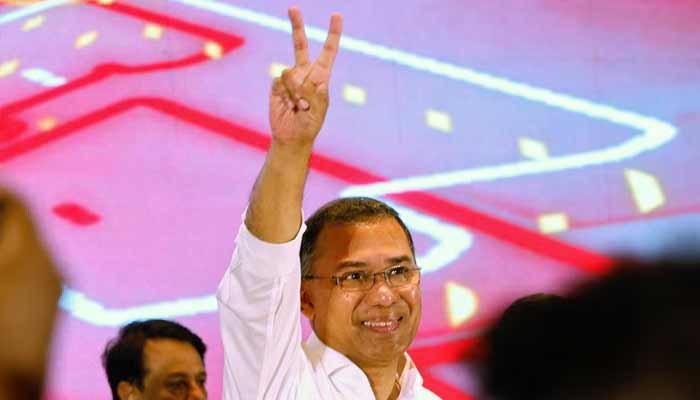
Tarique Rahman on Saturday dedicated his sweeping election victory to those who “sacrificed for democracy,” urging national unity following Bangladesh’s first general elections since the deadly 2024 uprising.
Pakistan, India Set for High-Voltage T20 World Cup 2026 Clash in Colombo
The chief of the Bangladesh Nationalist Party (BNP) is set to become the country’s next prime minister after his alliance secured a commanding parliamentary majority, winning 212 seats compared with 77 seats gained by the Jamaat-e-Islami-led opposition bloc, according to the Election Commission.
In his first speech after the polls, Rahman said the victory belonged to the people of Bangladesh and those who struggled for democratic freedoms. “Our paths and opinions may differ, but in the interest of the country, we must remain united,” he said.
Rahman will assume leadership from an interim administration headed by Nobel laureate Muhammad Yunus, which governed the South Asian nation after a student-led uprising ended the long rule of former prime minister Sheikh Hasina in August 2024.
The election marks a dramatic political comeback for Rahman, who returned to Bangladesh in December after 17 years in self-imposed exile in the United Kingdom. He is the son of former president Ziaur Rahman and former prime minister Khaleda Zia, figures who shaped Bangladesh’s political landscape for decades.
Opposition leader Shafiqur Rahman initially alleged irregularities in the vote but later conceded defeat, pledging to serve as a “peaceful opposition.” Meanwhile, the Awami League — barred from contesting the election — criticised the polls, with Hasina condemning them as unconstitutional from exile in India.
International observers, including the European Union, described the elections as credible, while global powers including the United States, India, China, and Pakistan congratulated Rahman on what was widely termed a historic mandate.
The Election Commission reported a turnout of 59 percent across 299 constituencies. Although only seven women won direct seats, an additional 50 reserved parliamentary seats for women will be filled through party nominations.
Alongside parliamentary voting, citizens approved a referendum introducing sweeping democratic reforms aimed at preventing one-party dominance, including term limits for prime ministers, enhanced presidential authority, judicial reforms, and the creation of an upper house of parliament.
Despite the decisive victory, Rahman acknowledged major challenges ahead, citing a fragile economy, weakened institutions, and deteriorating law and order as priorities for the incoming government.