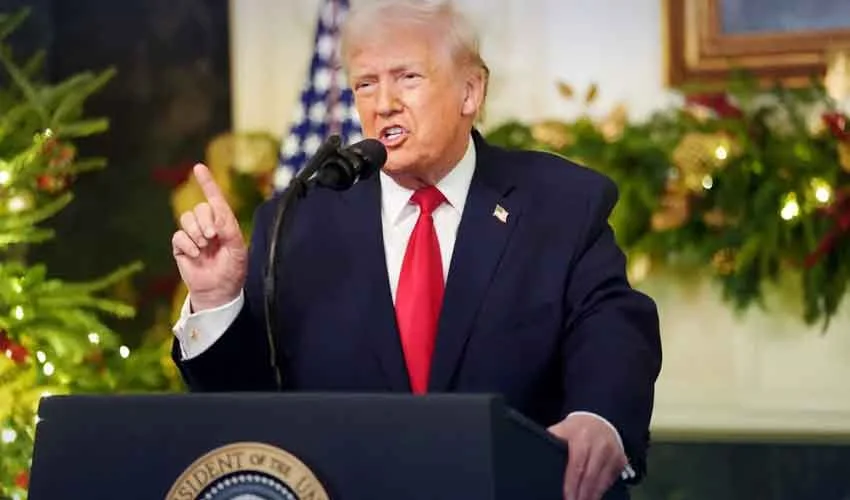
US President Donald Trump said on Wednesday that the United States should allocate $1.5 trillion for its military budget in 2027, a sharp increase from the $901 billion defense budget approved by Congress for 2026. The announcement sent defense stocks higher but triggered skepticism among budget experts and fiscal watchdogs.
Spotify Introduces Real-Time Listening Activity and ‘Request to Jam’ for Social Music Sharing
Any increase of this scale would require congressional approval, potentially posing a challenge. However, Trump’s Republican Party holds narrow majorities in both the Senate and the House of Representatives, and lawmakers have so far shown little resistance to the president’s spending proposals.
In a post on Truth Social, Trump said the decision came “after long and difficult negotiations with Senators, Congressmen, Secretaries, and other Political Representatives,” citing what he described as “very troubled and dangerous times.”
The announcement follows a period of heightened military and geopolitical activity. In recent days, US forces captured Venezuela’s President Nicolas Maduro, removing him from power. The White House has also confirmed that Trump is exploring options to acquire Greenland, including potential military involvement. Domestically, Trump has deployed US troops to assist in policing several American cities.
In a separate Truth Social post, Trump criticized defense contractors for slow weapons production and vowed to block companies from paying dividends or buying back shares until manufacturing speeds improve.
Trump said the proposed increase in military spending would be funded through revenues generated by tariffs imposed on nearly all countries and multiple industrial sectors. He also claimed the US would still be able to reduce national debt and issue dividend payments to “moderate-income” Americans.
Budget analysts have raised concerns over the proposal’s feasibility. The Committee for a Responsible Federal Budget estimated the plan would cost $5 trillion through 2035, adding $5.8 trillion to the national debt when interest is included. The group said only about half of the cost could be covered by existing tariffs and warned that the Supreme Court could rule many of the tariffs illegal.
Meanwhile, the Bipartisan Policy Center estimates tariffs raised $288 billion in 2025, significantly below Trump’s recent claims of around $600 billion.
Defense analyst Byron Callan of Capital Alpha Partners said the proposal raises serious questions about whether the defense sector could absorb such a dramatic funding increase. He noted that the last comparable surge occurred in 1951 during the Korean War, while even the Reagan-era military buildup in the early 1980s peaked at increases of 25% and 20%.
Despite the uncertainty, investors reacted positively. In after-hours trading, shares of major defense contractors surged, with Lockheed Martin rising 6.2%, General Dynamics up 4.4%, and RTX gaining 3.5%.