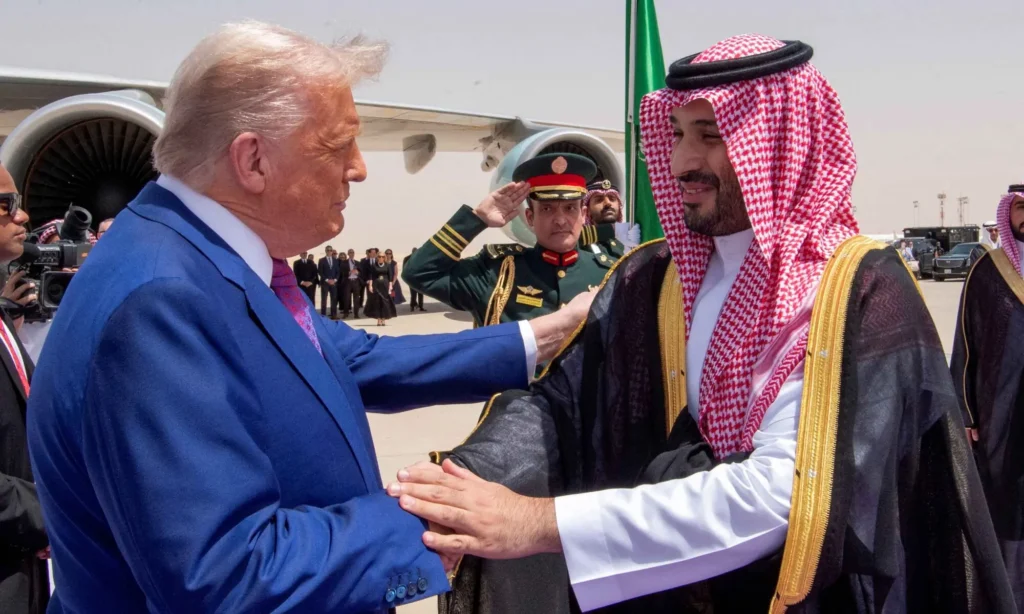
US President Donald Trump said on Monday that he plans to approve the sale of American-made F-35 fighter jets to Saudi Arabia, speaking just a day before hosting Saudi Crown Prince Mohammed bin Salman for high-level talks at the White House.
“I will say that we will be doing that. We’ll be selling the F-35s,” Trump told reporters in the Oval Office.
If finalised, the deal would represent a major shift in longstanding US policy, potentially reshaping the Middle East’s military balance and raising fresh questions about Washington’s commitment to ensuring Israel’s qualitative military edge (QME) — a key principle governing US arms sales in the region.
Earlier this month, Reuters reported that Saudi Arabia had requested up to 48 F-35 jets, a multi-billion-dollar purchase that had already cleared an important Pentagon review ahead of the crown prince’s Washington visit.
A senior White House official told Reuters that Trump intended to discuss the matter with Prince Mohammed before making a final decision, but the president’s remarks on Monday appeared to indicate a green light.
Strategic Interests and Regional Dynamics
Saudi Arabia — the largest buyer of US arms — has long sought the fifth-generation stealth fighter as it works to modernise its air force and counter regional threats, particularly from Iran. The Saudi Air Force currently operates a fleet that includes F-15s, Tornados, and Eurofighter Typhoons.
The Pentagon has been reviewing the potential sale for months, according to US officials who spoke to Reuters on the condition of anonymity.
Any sale of advanced military equipment to Arab states is weighed against Washington’s requirement to ensure that Israel maintains a superior technological advantage in the region. Israel has operated the F-35 for nearly a decade and remains the only Middle Eastern nation equipped with the aircraft.
Diplomatic and Political Considerations
The possibility of Saudi Arabia obtaining the F-35 has also been tied to broader diplomatic initiatives. Under the Biden administration, the jets were discussed as part of a proposed comprehensive agreement that included the prospect of Saudi-Israeli normalisation — a process that ultimately stalled.
Even with Trump’s support, Congressional approval remains a potential hurdle. Lawmakers have previously raised concerns over arms sales to Riyadh, especially after the 2018 killing of journalist Jamal Khashoggi, and some in Congress remain skeptical about expanding defence ties with the kingdom.
As Trump prepares to meet Prince Mohammed for a day of diplomacy, the F-35 issue is expected to be a central point of discussion — one with implications for defence policy, regional power dynamics, and US-Saudi relations.