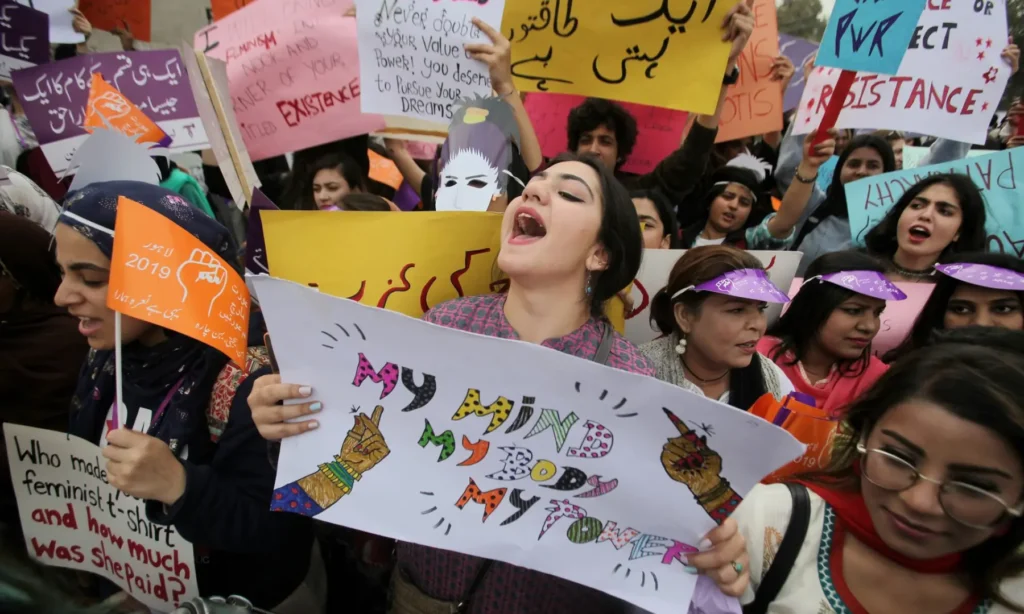
ISLAMABAD: A recent Supreme Court (SC) judgement setting aside a rape conviction and reclassifying it as fornication has reignited intense debate over women’s safety, consent, and judicial sensitivity in Pakistan.
NASA Orders First-Ever Early ISS Return After Astronaut Suffers Medical Condition
Earlier this month, the apex court reduced a man’s 20-year rape sentence to five years after ruling the act as consensual sex outside marriage, slashing the fine from Rs500,000 to Rs10,000. The decision has alarmed women’s rights advocates, who warn it may further discourage survivors from reporting sexual violence.
Ayesha Farooq, chairperson of the government-notified Committee under the Anti-Rape Investigation and Trial Act 2021, said such rulings undermine confidence in the justice system. “They do not give women confidence to come forward and report sexual violence,” she said.
Despite progressive legislation, underreporting remains severe. Around 70 per cent of gender-based violence (GBV) cases are never reported, while conviction rates remain dismally low at around 5 per cent nationally. Some categories record conviction rates as low as 0.5 per cent, while domestic violence convictions stand at just 1.3 per cent.
Senator Sherry Rehman highlighted the disparity between reported cases and convictions. In 2024, Islamabad recorded seven convictions out of 176 rape cases. Khyber Pakhtunkhwa saw one conviction from 258 cases, Sindh reported none despite 243 cases, and Balochistan recorded no convictions out of 21 reported cases.
Legal precedent or social regression?
Nida Aly, Executive Director of the AGHS Legal Aid Cell, described the judgement as deeply disappointing. “Judges have failed as a gender-competent forum and lost credibility,” she said.
The case involved a survivor who was raped at gunpoint in 2015 while relieving herself in a wooded area. Although DNA evidence confirmed the accused as the father of her child, and both the trial court and Lahore High Court upheld the rape conviction, a majority of the Supreme Court bench reclassified the offence as fornication. The judges cited delayed reporting, lack of resistance, and absence of physical injuries as grounds for their decision.
This reasoning drew sharp criticism from the National Commission on the Status of Women, which stressed that consent cannot be inferred from silence, delayed reporting, or lack of physical resistance. The commission urged courts to recognise the realities of trauma, fear, coercion, and power imbalance in sexual violence cases.
Justice Ayesha Malik, in a dissenting note, emphasised that there is no “standardised” reaction to rape and underscored the centrality of consent.
Rights advocates also pointed to a pattern in similar rulings. Aly recalled another 2024 case where a rape conviction was similarly reduced to fornication due to lack of resistance and a short reporting delay.
Marriage, consent and the law
Controversy has also surrounded judicial interpretations of marital rape. In one case, the Lahore High Court dismissed rape charges against a husband who allegedly raped his wife at gunpoint, ruling that the act did not constitute a crime because the marriage was still legally valid.
Legal experts argue this interpretation ignores legislative reforms. The Protection of Women (Criminal Law Amendment) Act 2006 removed marriage as a defence to rape by deleting the phrase “not his wife” from the legal definition. Subsequent amendments, including those in 2021, did not restore any marital exemption.
Maliha Zia of the Legal Aid Society explained that while marriage is no longer a legal defence, ambiguity in the law has allowed outdated assumptions to persist. Dr Sharmila Faruqui, an MNA, said the 2006 reforms were a major step forward but stopped short of explicitly criminalising non-consensual sex within marriage. “Marriage was never meant to be a licence for violence,” she stressed, calling for clearer legislation.
UN Women’s Pakistan Representative Jamshed M. Kazi warned that such judgements resonate far beyond the courtroom, shaping public attitudes and eroding survivor confidence. “They may discourage reporting and reinforce silence and fear,” he said.
Systemic challenges remain
While Pakistan established 174 special courts under the Anti-Rape Act 2021, these courts are not exclusively dedicated to GBV cases. Even so, Sindh’s rape conviction rate rose from 5 per cent in 2020 to 17 per cent in 2025. Advocates argue that exclusive GBV courts in high-caseload districts could further improve outcomes.
Legal experts agree that sustained judicial sensitisation and clearer laws centred on consent, dignity, and equality are essential to restoring trust and ensuring justice for survivors.