Balochistan CM Vows End to Enforced Disappearances as Cabinet Approves Major Legal Reforms
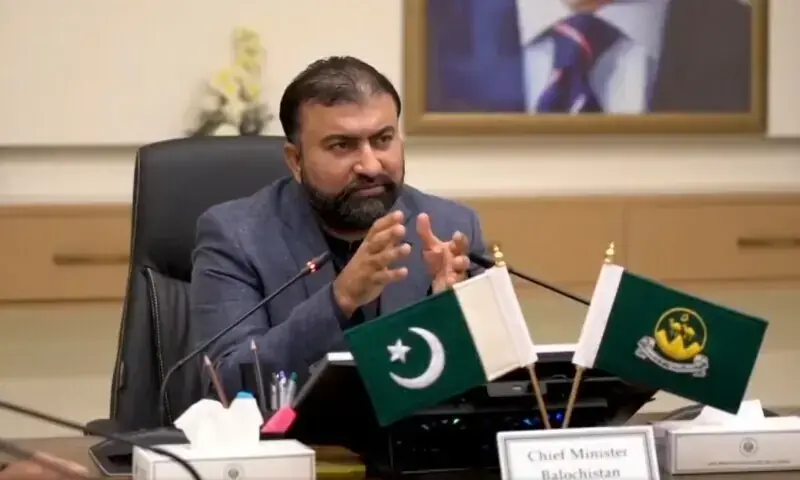
QUETTA: Balochistan Chief Minister Sarfraz Bugti said on Tuesday that the issue of missing persons had long been used as a propaganda tool against the state, adding that his government had introduced a comprehensive legal framework to address the matter on a permanent basis.
Death Toll in Karachi’s Gul Plaza Fire Rises to 28 as Search Continues
Chairing the 22nd meeting of the provincial cabinet at the Chief Minister’s Secretariat, the chief minister said that despite similar or even higher numbers of missing persons cases in other provinces, particularly Khyber Pakhtunkhwa, the issue in Balochistan had been politically exploited for years without any meaningful effort to reach a lasting solution.
Mr Bugti said that from February 1 onwards, no enforced disappearance would take place under the authority of the state or the provincial government. He added that the newly enacted legislation would help counter allegations of enforced disappearances and neutralise negative propaganda directed at Pakistan.
He acknowledged that security forces in Balochistan often operate in sensitive environments and conduct intelligence-based operations where suspects are detained for investigation. However, he stressed that the new legal framework would ensure transparency, accountability and oversight.
The chief minister clarified that if individuals were abducted by terrorist groups or went into hiding voluntarily, responsibility could not be attributed to the state. He noted that courts and relevant commissions already existed to examine claims of enforced disappearances, but unverified allegations were often amplified to promote anti-state narratives.
To address these concerns, the cabinet approved rules under the Balochistan Prevention of Detention and De-radicalisation Act, 2025. Under the law, designated centres have been established where suspects will be investigated under the supervision of authorised police officers and provided counselling to counter extremism and anti-state indoctrination.
Families of detainees will be informed within 24 hours, granted visitation rights and provided medical facilities. No individual will be transferred outside these designated centres.
The cabinet also approved the Balochistan Witness Protection (Amendment) Bill, 2025. The chief minister said that the absence of an effective witness protection mechanism in the past had resulted in extremely low conviction rates in terrorism and serious criminal cases. Under the new reforms, witnesses will testify through faceless courts, with their identities kept fully confidential to improve conviction outcomes.
The cabinet expressed satisfaction over merit-based recruitment conducted through online testing in the Finance Department and decided to gradually digitalise recruitment processes across all provincial departments.
Among other decisions, the cabinet approved the abolition of the Religious Affairs Department, with staff to be adjusted in other departments, the creation of two new divisions — Pishin and Koh-i-Suleman — administrative realignment of Ziarat with Loralai, and the establishment of Municipal Committee Karbala in Pishin district.
The cabinet also approved policies for evaluating law officers, amendments to grant-in-aid rules for minority affairs, measures to curb child labour, the declaration of higher technical education as an essential service and verification of academic credentials of contract teachers.
The chief minister directed the Chief Minister’s Inspection Team to begin degree verification, warning that FIRs would be registered against individuals holding fake credentials, starting from Nasirabad and Dera Bugti.
Education-related decisions included adopting the national curriculum from the academic year 2026-27, launching the Chief Minister Academic Excellence Programme and hiring ad-hoc teachers for mathematics, science and English at middle, high and higher secondary levels.
In the social sector, the cabinet approved the Balochistan Protection and Promotion of Reproductive Health Rights Bill, 2026, aimed at improving maternal and child health, expanding access to family planning services and safeguarding basic reproductive health rights.