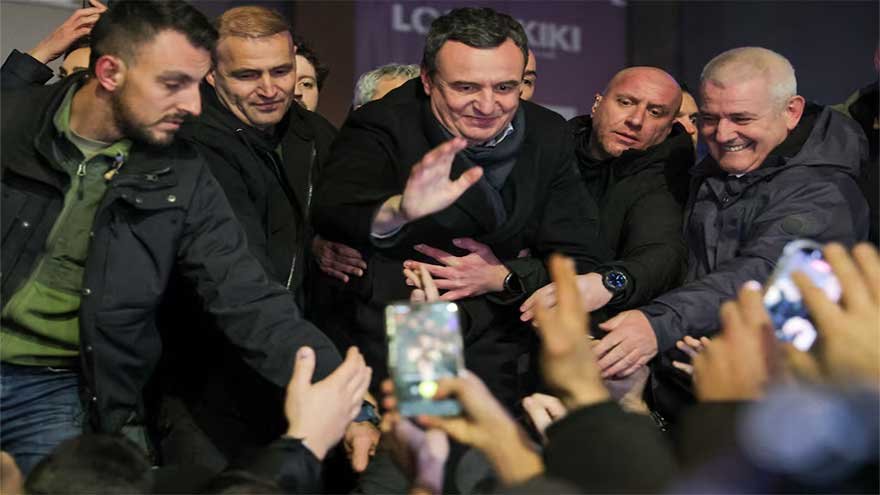
Kosovo Prime Minister Albin Kurti has vowed to swiftly form a new government after his Vetevendosje Party emerged as the clear frontrunner in Sunday’s parliamentary election, raising hopes of ending a year-long political deadlock that has paralysed parliament and delayed critical international funding.
Bilawal Bhutto Says Sindh Health Sector Improved Significantly After 18th Amendment
With 99% of the votes counted, Kurti’s party secured 49.3% of the vote, stopping just short of an outright majority in the 120-seat assembly. The election was Kosovo’s second this year, after months of failed coalition talks prompted President Vjosa Osmani to dissolve parliament in November and call an early vote.
“Once the results are certified, we should swiftly constitute the parliament and immediately form a new government,” Kurti told a press conference at his party’s headquarters. “We don’t have time to lose and must move forward as fast as possible.”
Kurti urged opposition lawmakers to support the approval of international loan agreements, which require a two-thirds majority. Kosovo must ratify nearly one billion euros in loan deals from the European Union and the World Bank, which are set to expire in the coming months.
Supporters of Vetevendosje celebrated in the streets of Pristina, chanting Kurti’s name and waving party flags as fireworks lit the night sky in freezing temperatures.
Political analysts cautioned that it remains uncertain whether Kurti can form a government without coalition partners, as votes from the diaspora and conditional ballots have yet to be counted. “I don’t see how Kurti will govern alone, but forming a small coalition would be relatively easy,” said Ismet Kryeziu of the Kosovo Democratic Institute.
The Democratic Party and the Democratic League followed with 21% and 13.6% of the vote, respectively. Analysts say Kurti needs only limited support from Albanian or minority parties to secure the 61 seats required to form a government.
Failure to establish a new government would prolong the crisis at a critical time, with parliament required to elect a new president in April. Opposition parties have repeatedly refused to govern with Kurti, criticizing his handling of relations with Western allies and tensions in Kosovo’s Serb-majority north. Kurti, in turn, has blamed the opposition for blocking governance.
During the campaign, Kurti pledged higher public-sector wages, increased capital investment, and the creation of a new prosecution unit to combat organised crime. Voter turnout stood at 45%.
Kosovo declared independence from Serbia in 2008 with strong US backing. Despite international support, the country continues to face economic challenges, political instability, and tensions with Serbia, which escalated in 2023 and led to temporary EU sanctions.