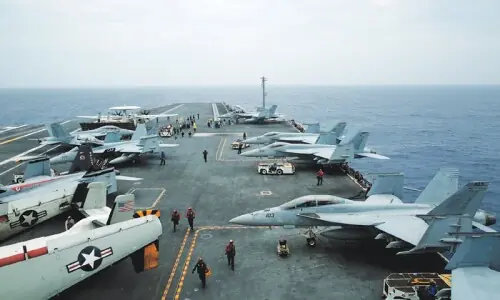
President Donald Trump has said the United States is deploying a large naval force toward the Gulf region and closely monitoring Iran, even as he downplayed the likelihood of imminent military action and indicated Tehran appeared open to talks.
Customs Slashes Valuation Rates on Used Smartphones to Ease Consumer Burden
Trump has repeatedly kept the option of further military action against Iran on the table following Washington’s backing of Israel during a 12-day conflict in June that targeted Iran’s nuclear and ballistic missile programmes. However, recent days have seen a reduction in tensions, with both sides signalling a willingness to allow diplomacy a chance.
Speaking to reporters aboard Air Force One while returning from the World Economic Forum (WEF) in Davos, Trump said the United States was sending a “massive fleet” toward Iran as a precautionary measure.
“We’re watching Iran,” he said. “I’d rather not see anything happen, but we’re watching them very closely.”
Addressing the WEF earlier on Thursday, Trump said the United States had struck Iranian uranium enrichment facilities last year to prevent Tehran from developing a nuclear weapon — a claim Iran continues to deny, insisting its nuclear programme is purely peaceful.
“Can’t let that happen,” Trump said, adding that Iran “does want to talk, and we’ll talk.”
Meanwhile, Iran’s Islamic Revolutionary Guard Corps (IRGC) also struck a defiant tone. Its commander warned Washington that Iranian forces had their “finger on the trigger,” signalling readiness to respond to any aggression.
Iran has faced weeks of unrest since late December, with protests challenging the leadership of Supreme Leader Ayatollah Ali Khamenei. The demonstrations have largely subsided following a crackdown that included an unprecedented nationwide internet blackout.
Last week, Trump stepped back from a threat to strike Iran over its handling of the protests after the White House said Tehran had halted planned executions of demonstrators. However, rhetoric between the two sides has continued to escalate. On Tuesday, Trump warned Iran’s leadership that the United States would “wipe them off the face of this Earth” if there were any attempt on his life in retaliation for an attack on Khamenei.
Iranian President Masoud Pezeshkian, speaking on Thursday, accused the United States and Israel of fuelling the protests as a “cowardly revenge” for what he described as their defeat in the 12-day war.
IRGC commander General Mohammad Pakpour warned Israel and the United States to “avoid any miscalculations” and learn from the recent conflict, cautioning that further confrontation could lead to “a more painful and regrettable fate.” He said Iranian forces were fully prepared to act on the orders of the supreme commander-in-chief.
Separately, General Ali Abdollahi Aliabadi, head of Iran’s joint command headquarters, warned that in the event of a US attack, “all US interests, bases and centres of influence” would be considered “legitimate targets” for Iranian forces.