Pakistan Urges UN to Curb Veto Power as Part of Comprehensive Security Council Reform
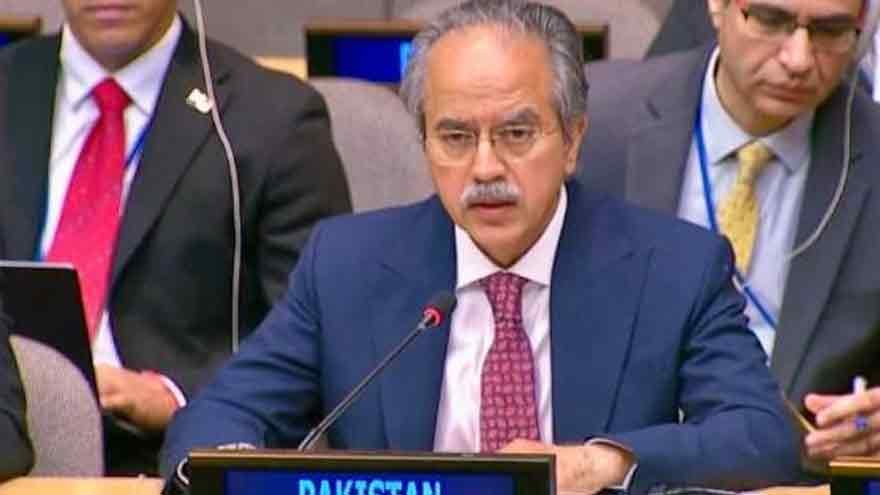
Pakistan has told the United Nations General Assembly that the issue of veto power—held exclusively by the five permanent members of the Security Council—must be addressed as part of broader reforms to make the 15-member body more effective in maintaining international peace and security.
E-Challan Fines in Karachi Will Not Be Reduced, Says Sindh LG Minister
Speaking during a debate on the use of the veto, Pakistan’s Permanent Representative to the UN, Ambassador Asim Iftikhar Ahmad, said the Security Council has frequently been immobilized by the strategic rivalries of its permanent members: China, France, Russia, the United Kingdom, and the United States.
“It comes as no surprise therefore, and past and recent experiences have confirmed, that the abolition or restraint on the use of the veto will have to be an integral part of the reform of the Security Council,” he stated.
Ambassador Ahmad noted that recent proposals aim to strengthen the General Assembly’s role without interfering with the ongoing Inter-Governmental Negotiations (IGN) on Security Council reform. Under a 2022 General Assembly resolution, the Assembly must automatically convene within 10 days whenever a permanent member employs the veto, in an effort to ensure accountability for its use.
Reaffirming Pakistan’s long-standing position, the envoy said the country—along with the Uniting for Consensus (UfC) group—opposes the creation of new permanent seats on an expanded Council. “More permanent members and more vetoes will only aggravate the problem, and multiply the likelihood of paralysis or inaction,” he told the 193-member body. “The problem cannot be the solution.”
Reform efforts have remained stalled as the Group of Four — India, Brazil, Germany, and Japan — continue pressing for permanent membership. As an alternative, the UfC has proposed a new category of longer-term, non-permanent seats with the possibility of re-election.
Ambassador Ahmad suggested that the negative power of the veto could be balanced by restricting its use while simultaneously strengthening the role of non-permanent members through broader and potentially longer representation. However, he stressed that any such constraints must remain consistent with the UN Charter.
“The final resolution of the issue of the veto will have to be found as an integral part of the reform of the Security Council,” he concluded.
Opening the debate, General Assembly President Annalena Baerbock warned that persistent deadlock in the Council has become emblematic of global paralysis, eroding confidence in multilateral institutions. She said the UN, created to “save succeeding generations from the scourge of war,” cannot deliver on its founding mandate when the Council is blocked by a single veto.
“Real people, watching in real time, may question the credibility and legitimacy of not only the Security Council, but of the UN in its entirety,” she cautioned, noting that the Council has been paralyzed in addressing several of the world’s most devastating conflicts.