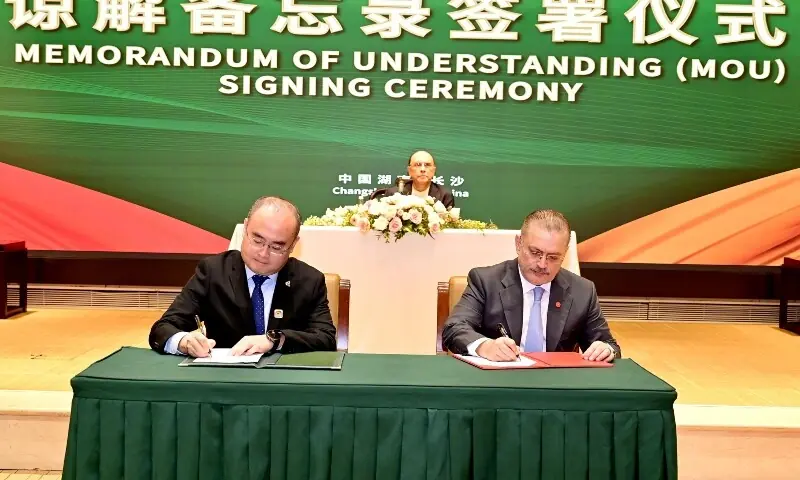
Beijing/Changsha — Pakistan and China on Monday signed three Memorandums of Understanding (MoUs) aimed at expanding bilateral cooperation in water desalination, agricultural technology, and the tea industry, as part of ongoing efforts to deepen economic and development ties.
Pakistan Moves to Curb HIV Surge as Global Fund Visit Expected Amid Concerns Over Reused Syringes
The agreements were witnessed by Asif Ali Zardari, who is currently on a week-long official visit to China focused on trade and economic cooperation.
The first MoU was signed between the Sindh local government and Lucion Environmental Technology Group for a seawater desalination project in Karachi. The initiative aims to enhance the city’s water supply capacity amid growing demand.
The second agreement involved collaboration between the Sindh local government and Long Ping Hi-tech Information Company to promote agricultural technology development and innovation. The MoU was signed by Sindh Senior Minister Sharjeel Inam Memon along with Chinese representatives.
The third MoU was signed between Meskay & Femtee Trading Company, Hunan Tea Group Co Ltd, and Jiaolong International Technology to strengthen cooperation in the tea sector and enhance trade, industry development, and people-to-people linkages between the two countries.
The signing ceremony was attended by senior officials including Senator Saleem Mandviwalla, Chief Secretary Sindh Syed Asif Hyder Shah, and Pakistan’s Ambassador to China Khalil Hashmi.
In a separate development, President Zardari conferred the Sitara-i-Pakistan award on Pan Xiangbin in recognition of his contributions to cardiac care, particularly in treating Pakistani children with congenital heart disease and training local medical professionals.
Earlier, during his engagements in Hunan province, the president emphasized Pakistan’s interest in expanding cooperation with China in seed technology, agricultural research, and modern farming practices, reflecting a broader push toward strengthening bilateral economic and technological collaboration.
Officials from both countries described the MoUs as a step toward practical cooperation in key development sectors and deeper strategic engagement.